

Dubai and Turkey are both popular places for a hair transplant, and each draws many patients from the Gulf and beyond. The real differences for most travellers are practical: journey time, how easily you can return for follow-up, and the climate while you heal. Safety depends on the specific clinic and team, not on the country.
This comparison walks through those practical factors, then sets out the questions worth asking any clinic before you book.
Why do people choose Dubai or Turkey for a hair transplant?
Both are well known for hair restoration and welcome many international patients. Both are also major travel hubs, with direct flights from much of the world.
Similar techniques are widely available in each, including FUE and DHI (Direct Hair Implantation). For people living in the Gulf, the decision often comes down to logistics rather than method.
So rather than asking which country is better, ask which option fits your life over the year the result takes to show.
How do travel and timing compare from the Gulf?
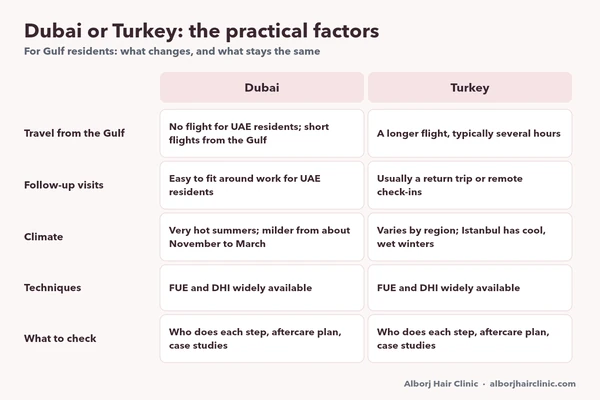
For UAE residents, Dubai means no flight at all. From elsewhere in the Gulf, it is usually a short hop. Turkey involves a longer journey, typically several hours from Gulf cities.
Journey time matters most after the procedure. A freshly treated scalp needs protecting from bumps, headrests and tight hats, and a longer trip means more time to manage that.
- Ask the clinic how soon you can fly, and what to do during the journey.
- Allow enough nights for any check-up the clinic wants before you leave.
- Pack a button-up top and a loose covering approved by your clinic for the trip home.
Time away from work counts too. A trip that ends with a short flight, or none, can mean fewer days of leave.
How easy is follow-up once you are home?
This is where location makes the clearest difference. A transplant is not a one-visit event: new growth usually starts at about three months, and the full result appears at around 12 months.
Surgeons commonly like to review progress along the way. How easily that happens depends on where you live:
- If you live in the UAE, a Dubai clinic is a drive away, so check-ups can fit around a working week.
- If you travel abroad, follow-up usually means a return trip or remote check-ins, so ask exactly how each clinic handles it.
Wherever you go, ask before booking who will review you at around three months and at a year. Also ask how to reach the team if something worries you in the first weeks.
“Wherever a patient goes, I suggest the same two questions: who performs each step, and who will see you as the hair grows in. The result takes about a year, so follow-up is part of the treatment, not an extra.”
What does aftercare look like in either place?
The basics of aftercare are much the same wherever the procedure happens. What changes is where you spend the first days, and how easily you can ask a question in person.
- The first days. Protect the grafts from knocks and rubbing, resist scratching, and wash the scalp only as the clinic shows you.
- The first weeks. Many clinics advise putting off swimming, hard exercise, tight headwear and strong sun for a while. Your own surgeon sets the exact timings.
- The first months. Shedding and then regrowth are part of the normal process, and a check-up helps confirm all is on track.
For a UAE resident treated in Dubai, recovery usually happens at home, close to the clinic. Travelling abroad means the first days are spent in a hotel and then on a flight, so plan them with care.
How does the climate affect recovery?
Heat, sweat and strong sun are hard on a healing scalp, and both destinations can be warm in summer. The difference is one of degree and timing.
- Dubai is very hot and humid from around June to September. From roughly November to March it is much milder, and many people prefer to travel then.
- Turkey varies by region. Istanbul, for example, has warm summers and cooler, often wet winters.
In any climate, the early weeks call for shade, a clean scalp and no tight headwear. Ask the clinic how to adapt the aftercare to the season you travel in.
What should you check wherever you go?
The questions that protect you are the same in Dubai, Istanbul or anywhere else:
- Who performs each step. Ask which parts the surgeon carries out personally and which are done by the team.
- The surgeon’s experience. Ask how many years they have worked in hair restoration and roughly how many procedures they have performed.
- Professional membership. Ask whether the surgeon belongs to a professional body such as the International Society of Hair Restoration Surgery (ISHRS).
- The plan. Ask which technique is proposed and how the design allows for future thinning of the surrounding hair.
- Aftercare and follow-up. Get the aftercare plan in writing, with clear details of follow-up after you leave.
- Case studies. Look at the clinic’s own case studies, ideally showing results at around a year.
A clinic that answers these clearly and patiently gives you a far sounder basis for a decision than a destination alone.
About Alborj Hair Clinic
Alborj Hair Clinic is a hair transplant clinic in Mazaya Centre, Al Wasl, Dubai. Its surgeon, Dr Dimitrios Ziakas, has 24 years of experience and has performed more than 4,000 hair transplant procedures. He is a member of the International Society of Hair Restoration Surgery (ISHRS) and uses the DHI (Direct Hair Implantation) technique.
UAE residents who want to talk through aftercare and follow-up before deciding can contact Dr Dimitrios Ziakas at Alborj Hair Clinic.
The clinic publishes before-and-after case studies on its website.
Frequently asked questions
Is a hair transplant safer in Dubai or Turkey?
Safety depends on the clinic, the surgeon and the team, not the country. Ask the same questions wherever you go about who performs each step and how aftercare works.
Can I have the procedure abroad and check-ups in the UAE?
Ask the clinic that performs the procedure how follow-up will work. The team that planned your transplant knows your case best.
Does the technique differ between the two?
Not by country. Methods such as FUE and DHI are offered in both, so ask each clinic which one it proposes for you and why.
Which season is easier for recovery?
Cooler months are usually more comfortable, since heat and sweat irritate a healing scalp. In Dubai, that tends to mean roughly November to March.